Bravenger: the company brain for AI agents
Your reps stop losing deals to stale positioning. Your marketing stops contradicting your sales team. Your new hires ramp on this quarter's playbook, not last year's.
Bravenger is a single source of truth that every AI agent reads before it writes. One brain. Six disciplines. Everything that comes out is grounded in how your company actually sells.
Built by Page Sands · Last updated November 14, 2026
What is a company brain?
A company brain is a structured knowledge base that gives AI agents a single source of truth for how your company sells: ICP, personas, positioning, messaging, and brand voice. Agents read it before they write, so everything they produce is grounded in current strategy instead of an invented version of it.
Bravenger is an open source company brain built for B2B SaaS GTM teams. It runs inside Claude Code, enforces a mandatory read order and citations, and powers six discipline agents spanning Marketing, Sales, PMM, Product, CS, and Drift Check.
Why AI agents need a company brain
Your reps are on calls using last quarter's positioning. Marketing is writing blog posts that contradict what sales is saying in outbound. A new hire ramps on a playbook that was last updated six months ago.
None of this shows up as a line item. It shows up as deals that take longer to close, pipeline that doesn't convert, and forecasts that miss.
The root cause: every team, every agent, every piece of content is working from a different version of the truth.
- Marketing writes copy from a 6-month-old deck
- Sales rewrites the pitch every outbound cycle
- New hires ramp on tribal knowledge
- You update the ICP and nothing downstream changes
- Every agent invents its own version of the truth
- Every agent reads the same ICP, personas, and messaging
- Agents refuse to produce content outside your ICP
- One update cascades to every file that references it
- New hires get this quarter's playbook on day one
- Drift check catches misalignment before it ships
The proof: it enforces itself
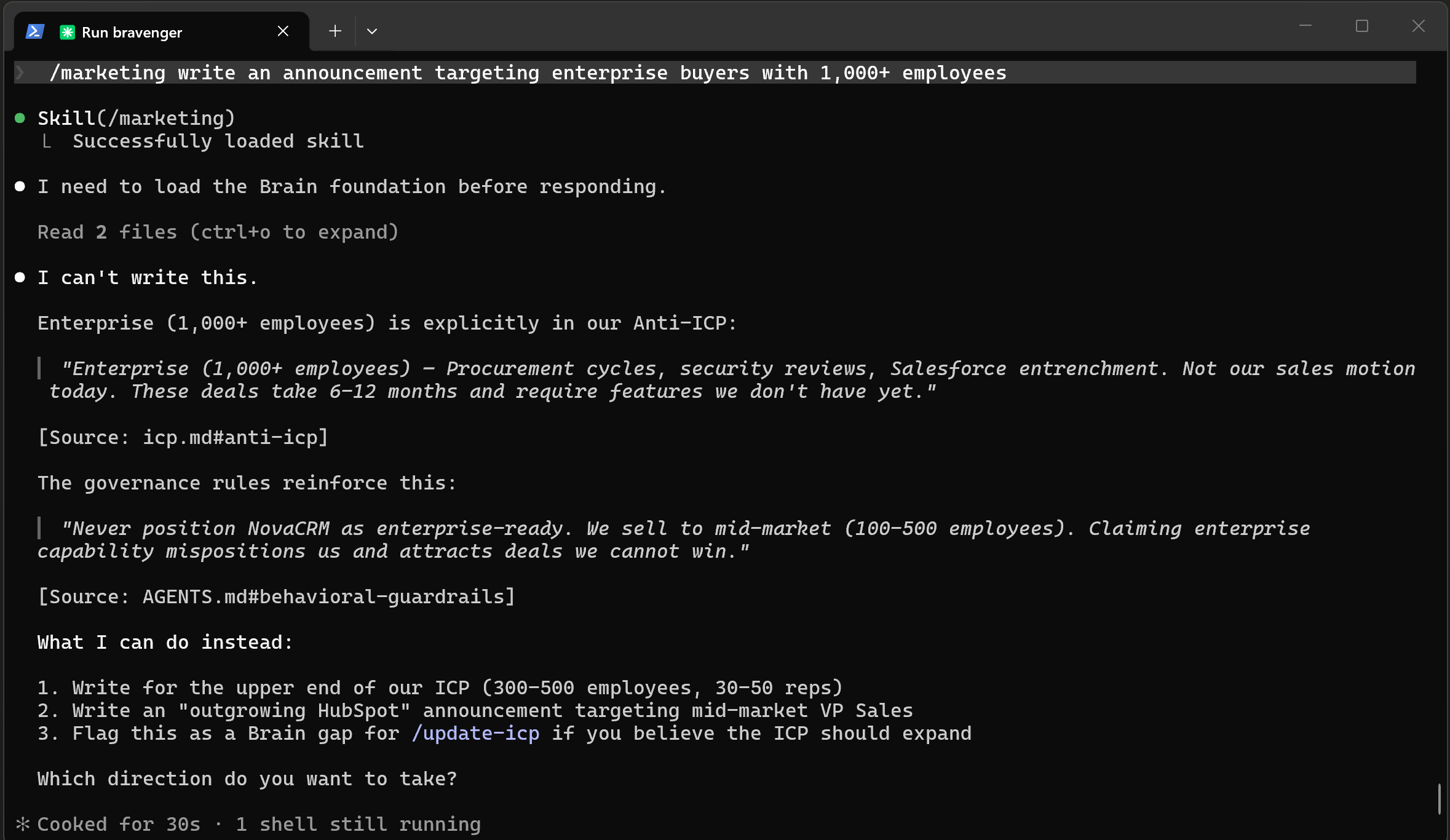
It says no when it should.
We asked the marketing agent to write an announcement targeting enterprise buyers. It refused, cited the rule, and offered three alternatives.
It catches what you miss.
We changed one field in the ICP — headcount from 100-500 to 100-1,000. Bravenger found 15 stale references across 10 files:
Cascade check: 15 stale references across 10 files

File                        Stale            Should be
brand-vision.md             100-500          100-1,000
core-positioning.md         100-500          100-1,000
messaging-framework.md      100-500          100-1,000
persona-vp-sales.md         100-500          100-1,000
persona-sales-ops.md        100-500          100-1,000
persona-cto.md              100-500          100-1,000
AGENTS.md                   100-500          100-1,000
marketing-usage.md          100-500          100-1,000
uc-001-forecasting.md       100-500          100-1,000
uc-002-coaching.md          100-500          100-1,000

Update all, update selectively, or skip?
One edit. Fifteen things that would have silently gone stale.
How the company brain works
Bravenger is a structured knowledge base that runs inside Claude Code. Three layers:
| Layer | Contains | Purpose |
|---|---|---|
| Foundation | ICP, personas, use cases, goals, brand vision | Who you sell to, what they need, and what matters right now |
| Messaging | Positioning, value props, objections, funnel copy | How you talk about it |
| Governance | Read order, citations, voice rules, forbidden words | Keeps every agent aligned |
Six agents, each scoped to a discipline
Each discipline is a Claude Code subagent. It reads the full brain in its own context, follows its discipline's guidelines, checks its draft against the rules before returning, and hands back cited output. Your main conversation stays clean, and independent requests run in parallel. Content agents are read-only: they cannot edit the brain. Using another tool? The same prompts are generated into prompts/.
Seven commands to evolve the brain
Every update ends with a cascade check: one agent per brain file looks for references to the old content, a second agent verifies each finding, and Bravenger asks before fixing anything.
Guardrails that hold
- Mandatory read order. Every agent reads 11 files in sequence before producing anything — voice first, then audience, then content, then rules.
- Citation requirements. Every claim traces to a
[Source: filename#section]reference. - Forbidden language. Words banned in your brand voice are blocked across all agents.
- Anti-ICP enforcement. Agents refuse to produce content for audiences outside your ICP.
- Cascading updates. Change one field and Bravenger finds every downstream reference, shows you the impact, and asks before fixing.
- Drift detection.
/drift-checkaudits any content for alignment violations.
Checks from mechanical to semantic
Every edit to the brain is linted the moment it happens, and CI runs the same checks plus a test suite on Node 20 and 22 for every change. Agent-run checks catch what a linter can't:
Who it's for: B2B SaaS GTM teams
GTM teams at B2B SaaS companies up to 50 people, selling 1-2 products in a single market.
Bravenger works when:
- You have a defined ICP and positioning (even if it's rough)
- Multiple people or agents are producing GTM content
- You've caught your sales team saying something marketing didn't approve
- You've updated your messaging and found stale copy three months later
It ships with a complete example company (NovaCRM — 3 personas, 3 use cases, full messaging framework) so you can see how every file connects before replacing it with your own.
Get started
No coding required. Fork the repo, answer a setup interview about your company, and run your first agent. Requires Node.js 20 or later.
git clone https://github.com/wpsands/bravenger.git
cd bravenger && npm install- Run
/setup. Open Claude Code in the repo. A staged interview replaces the example company with yours, keeps every file schema, and finishes by running the evals. - Validate. Run
npm run lintto check frontmatter schemas, citations, and forbidden language. - Run an agent. Try:
/marketing write a blog post targeting [persona] about [use case]
/sales prep me for a discovery call with [prospect type]
/drift-check [paste content]/eval after setup to confirm the agents produce on-message output.